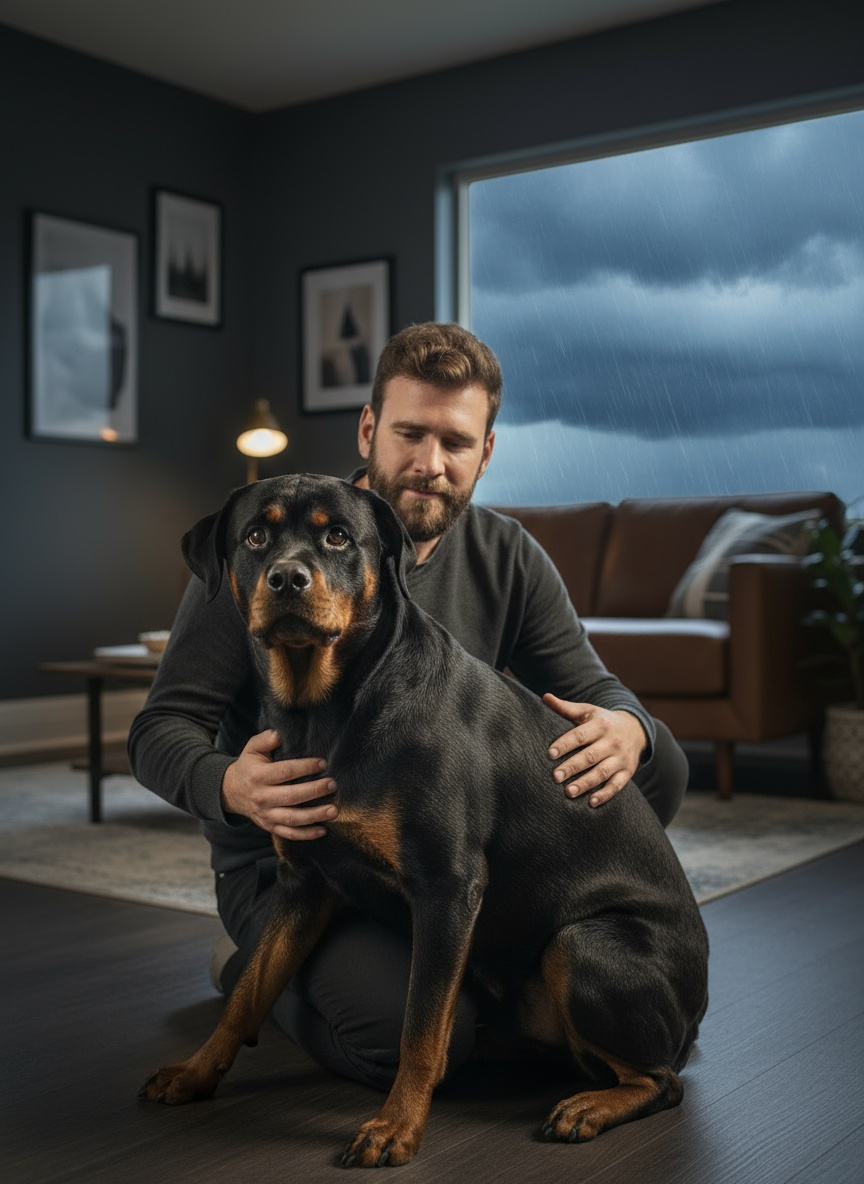
Summer in Queensland means afternoon storms, humidity, and the occasional hailstorm that rattles the roof. For many pets, it also means anxiety—shaking, hiding, pacing, or worse. If your dog or cat loses it every time the sky darkens, you’re not alone. Storm anxiety is one of the most common behavioural issues I see in practice, and it’s not something pets just “grow out of.”
Understanding why it happens and what you can do about it makes a real difference—not just for your pet, but for your own peace of mind too.
Why Storms Trigger Anxiety
Pets experience storms differently to us. Their hearing is far more sensitive, so thunder that sounds distant to you might feel overwhelming to them. Dogs can hear frequencies up to 65,000 Hz (compared to our 20,000 Hz), and cats aren’t far behind. That means they’re picking up on sounds we don’t even register—wind building, branches creaking, distant rumbles.
But it’s not just sound. Pets can also sense changes in barometric pressure and static electricity in the air. Some dogs will start pacing or panting before the first drops of rain even fall, because they’ve already felt the shift.
For some pets, storm anxiety develops after a single frightening experience. For others, it builds gradually over time. Either way, it’s a real fear response—not “bad behaviour” or attention-seeking.
What Storm Anxiety Looks Like


Every pet reacts differently, but common signs include:
- Panting, drooling, or trembling
- Pacing, restlessness, or inability to settle
- Hiding in unusual places (under beds, in closets, behind furniture)
- Destructive behaviour (scratching doors, chewing furniture)
- Vocalising (barking, whining, meowing)
- Trying to escape (bolting through doors, digging, jumping fences)
- Clinginess or following you around constantly
Cats tend to hide, while dogs are more likely to pace or become destructive. But both species can experience genuine distress.
Practical Strategies to Help Your Pet


1. Create a Safe Space
Give your pet somewhere they can retreat when storms roll in. This might be a quiet room with minimal windows, a walk-in wardrobe, or even a bathroom. The goal is to reduce sensory input—dim lighting, muffled sound, and a sense of enclosure.
Add familiar bedding, a worn t-shirt that smells like you, and leave the door open so they can come and go. Never force them into the space—it needs to feel like their choice.
2. Mask the Noise
White noise, calming music, or even a fan can help drown out the unpredictable sounds of a storm. There are playlists designed specifically for anxious pets (search “Through a Dog’s Ear” or similar). The idea isn’t to eliminate the noise entirely, but to make it less jarring.
3. Stay Calm Yourself
Pets are incredibly attuned to our emotions. If you’re rushing around closing windows and muttering about the weather, they’ll pick up on that tension. Stay relaxed, speak in a calm voice, and act like the storm is no big deal. You’re not ignoring their fear—you’re modelling that there’s nothing to panic about.
4. Distraction Can Help (Sometimes)
For mildly anxious pets, distraction with a favourite toy, puzzle feeder, or long-lasting chew can work. But if your pet is too stressed to eat or play, don’t push it. Forcing interaction when they’re overwhelmed won’t help.
5. Consider Calming Aids
There are several products that can take the edge off:
- Adaptil (dogs) or Feliway (cats): Pheromone diffusers that create a sense of calm.
- Thundershirts or anxiety wraps: Gentle pressure that can reduce anxiety in some pets (though not all respond).
- Supplements: Products containing L-theanine, tryptophan, or valerian root may help mild anxiety.
These aren’t magic fixes, but they can be part of a broader strategy.
6. Desensitisation Training (Long-Term)
If your pet’s anxiety is predictable and severe, desensitisation can help. This involves playing recordings of storm sounds at a very low volume while your pet is calm and relaxed, then gradually increasing the volume over weeks or months. Pair the sounds with positive experiences—treats, play, or affection.
This takes time and consistency, and it’s best done outside of storm season so your pet isn’t already on edge.
7. Medication for Severe Cases
For pets with severe storm phobia—those who injure themselves trying to escape, or who are inconsolable for hours—medication may be necessary. This isn’t about “drugging” your pet. It’s about reducing their distress to a manageable level so they can cope.
Options include:
- Sedatives or anxiolytics (given before storms, if you can predict them)
- Long-term anti-anxiety medication (for pets with chronic, severe anxiety)
This is something to discuss with your vet. Every pet is different, and what works for one might not work for another. Book an appointment with Dr Stu for a tailored solution.
What Doesn’t Help
- Punishment or scolding: Your pet isn’t misbehaving. They’re scared. Punishment will only make things worse.
- Forcing them out of hiding: If they feel safest under the bed, let them stay there.
- Ignoring severe anxiety: If your pet is genuinely distressed, hoping they’ll “get used to it” rarely works. Anxiety tends to worsen over time without intervention.
When to Get Help
If your pet’s storm anxiety is escalating, or if they’re injuring themselves or causing damage, it’s time to talk to a vet. There’s no shame in asking for help—storm phobia is a legitimate medical issue, and there are effective treatments available.
At PMV, I take the time to understand what’s happening for your pet and work with you to find a solution that fits your household. No rush, no judgment—just patient, practical care.
Final Thoughts
Storm anxiety is tough to watch, but it’s manageable. With the right approach, most pets can learn to cope better—or at least feel less distressed. Start with the basics (safe space, noise masking, staying calm), and build from there. And if you need support, reach out. That’s what I’m here for.
Dr Stuart | Personalised Mobile Vet admin@personalisedmobilevet.com.au www.personalisedmobilevet.com.au
References
Mills, D., Dube, M.B. & Zulch, H. (2013) Stress and pheromonatherapy in small animal clinical behaviour, Wiley-Blackwell, Chichester.
Overall, K.L. (2013) Manual of clinical behavioral medicine for dogs and cats, Elsevier, St Louis.
Levine, E.D., Ramos, D. & Mills, D.S. (2007) ‘A prospective study of two self-help CD based desensitization and counter-conditioning programmes with the use of Dog Appeasing Pheromone for the treatment of firework fears in dogs (Canis familiaris)’, Applied Animal Behaviour Science, vol. 105, no. 4, pp. 311–329.
Blackwell, E.J., Bradshaw, J.W.S. & Casey, R.A. (2013) ‘Fear responses to noises in domestic dogs: Prevalence, risk factors and co-occurrence with other fear related behaviour’, Applied Animal Behaviour Science, vol. 145, no. 1–2, pp. 15–25.











Leave a Reply